
VR Real Estate Marketplace: Immersive Property Tours and News.
By: Sara W
Introduction
To buy or sell a house used to mean you had to visit a property dozens of times and you had to photographic memory the listing photos to understand them in the context of reality. Fortunately, that’s changing. Technology is making the whole process more efficient and convenient. VR (Virtual Reality) is a large contributor to that.
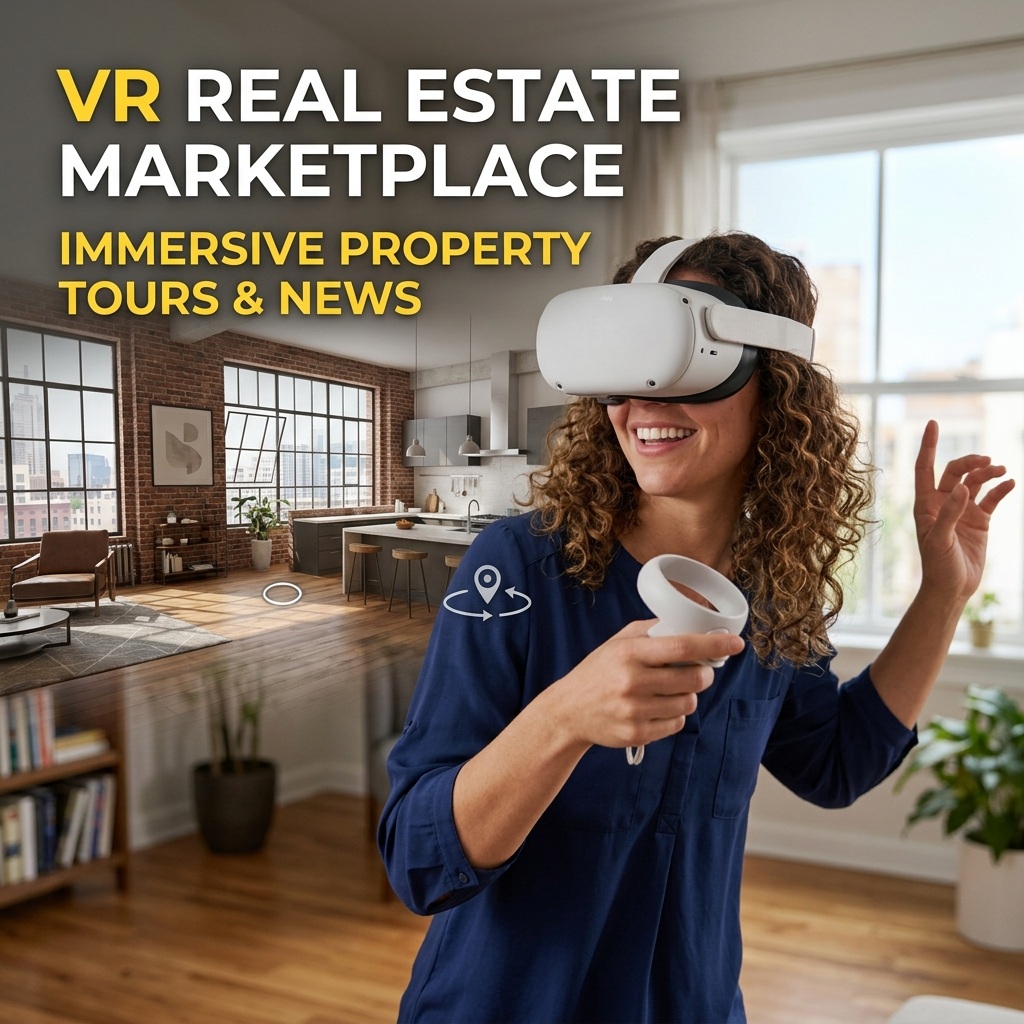
VR Real Estate Technology uses Virtual Reality Headsets in conjunction with 360 cameras and some technology to allow prospective home buyers to “walk” through virtually listed properties. Think of the new property search as if it’s an activity you could do from the comfort of your living room rather than scrolling through a series of still images. Prospective buyers can open doors, check out the height of a listing, watch the sun lacquer the room at different times throughout the day, and really gauge a listing. Agents can save time by having buyers virtually tour listings rather than hosting in person open houses.
This article dives into how VR Real Estate Marketplaces can aid both buyers and agents, model immersive property tours, and help understand the technology and capability, and where the market is headed. If you’re just interested in how or why PropTech is cool, or if you’re an agent or homebuyer looking to learn about a VR tour, this article has everything you need.
What Makes a VR Real Estate Marketplace Unique
Photographs, floor plans and perhaps a video walk-through. This is what you get from most property listings. While this is highly functional, it is entirely passive. The viewer can only look at what the photographer has captured from the angle they’ve chosen on the day of.
VR real estate totally transforms this. Rather than looking at a listing, the potential buyer is able to traverse a virtual model of each property. Some headsets and even some basic phone applications are enough to give potential buyers the ability to “look around” in a virtual kitchen or “move into” a hallway and “go into” a bedroom. Many of these applications provide the ability to change the flooring, paint the walls, and even place virtual furniture to provide a potential buyer with much more of a space and where their belongings might be placed.
This type of application generally consists of some sort of high-res or laser scanned model of the space which captures the geometry and dimensions of the space. These models are then stitched together in a piece of software which gives the end user a one of a kind walkthrough of the model. Finally, the virtual shop/marketplace is added which provides a potential buyer with the tools and information necessary to make an offer, all in one spot.
For agents, uploading scan data to vr real estate markets lets the data get converted to the appropriate format for browsing on desktop and mobile devices, along with VR headsets. This conversion and data formatting is a key feature in attracting most buyers, who still do the preliminary searching on mobile and desktop devices, rather than VR headsets. So the best virtual real estate marketplaces need to ensure that interactivity and functionality of tours do not get lost in cross-platform data conversions.
Why Immersive Property Tours Are Gaining Ground
There are several factors behind the growing preference for immersive property tours.
Remote Work and Distance Buying
Many people are moving to new cities on account of remote work. Software Engineer Johnson living in Chicago used to fly to Austin to attend ten property viewing sessions. However, he now prefers a VR tour instead to narrow down a list of twenty property viewings.
Agents Want to Sell
In current market conditions, a listing with an immersive tour way more enticing than one with just traditional property photos. Buyers tend to stay around longer, giving the listing a boost in search priority.
(Now included in the solution instructions for reader clarity)
The hardware is affordable enough to buy. Early virtual reality involved bulky tethered headsets and computers that cost thousands of dollars. Now, headsets are more lightweight, moved from wired technology to wireless, and many virtual reality estate tours work with smartphones. Because of this technology, there is no longer a need for a buyer to own special equipment to experience virtual reality.
Sellers desire speed. Listings that provide virtual reality technology allow interested individuals to learn everything they need to know about a listing to the extent that they become serious, qualified buyers who wish to view the property in person. This turns into a faster and less disruptive selling process.
The nascent technology of virtual reality is used by the commercial real estate industry, as well. Landlords of commercial real estate, such as office spaces, use virtual realty to give high quality tours to tenants who are interested in moving from another city or country. Virtual reality makes it possible for tenants to learn about all possible locations and make a choice without even visiting in person.
Real estate isn’t the only industry taking advantage of virtual reality. Virtual tour technology gives potential buyers a better and more informative way of seeing every aspect of a home, including an HVAC system or utility room. This has motivated buyers to ask about the state of a home’s air ducts, including if they were ever cleaned. It is just one example of virtual reality opening detailed, purchase related conversations earlier than before.
Evaluating VR Real Estate Platforms
Different vr real estate marketplaces employ different techniques. So knowing what features distinguish real VR real estate marketplaces from platforms that are more about marketing is really important.
Tour quality and Accuracy– The best marketplaces utilize actual spatial scans to create virtual tours, rather than collages of photos. Spatial scans mean that the dimensions and proportions of the rooms inside the tour match real life. That makes a big difference when prospective buyers want to make an informed decision on whether or not the tour shows a property where the furniture will fit or if a hallway will feel too narrow.
Cross-device Support- Tours can be great until they only work in vr. The best marketplaces support virtual tours on browsers, tablets, phones, and other devices.
Listing data integration- Virtual tours are only as good as the data they are integrated with. The best marketplaces integrate virtual tours with property pricing, square footage, tax/title data, school district information, and scheduling data so that a buyer does not have to look through multiple virtual tour data silos to gain access to the information they need to make a decision on a property.
Agent and seller support- Some companies provide the equipment and personnel to do the scans, while others require the agent to do the scan themselves with a camera of the company’s choice. Buyers of the agent’s services and agents utilizing the platform should evaluate training, scan turnaround time, and the cost.
Data privacy and security. Considering the digital footprint a vr real estate tour creates, buyers and sellers should consider where and with what level of security the digital record is stored. They should also verify a digital record is made unavailable to the public after the sale.
Realistic Hardware Expectations. There are options for real estate tours that do not require headset technology for the tour to provide real value. Smartphone tours in which the user tilts and swipes the screen to view a property provides more detail and information than a photo.
The Future of VR and Real Estate
Some technology emerging in the field of vr real estate will have a large impact on everything from how a real estate tour is used to how a real estate closing is completed.
AI generated staging. When a tour allows a user to digitally add furniture, a seller can save on the cost of traditional furniture staging. A buyer also has the ability to digitally “stage” the property with the architecture and staging they desire.
Vendor integrations. In the future, a potential buyer will be able to conduct a virtual tour of a property, obtain mortgage pre-approval, and digitally sign the closing docs, all as part of an interrelated real estate tech system.
Neighborhood Virtual Exploration. More advances in real estate technology show buyers the surrounding area of a property like the neighborhood via virtual tours. Virtual tools allow buyers to experience how far a property is from amenities by allowing them to virtually walk the streets and see how close amenities are from the property ie. parks/transportation.
Smaller Real Estate Companies. The adoption of virtual immersive experiences used to primarily target high end buyers in luxury real estate markets due to the high cost of technology and equipment required to perform virtual real estate tours. More companies will begin to take advantage of the equipment and software as it decreases in cost.
Renovation Financial Planning. With digital twins, room dimensions become digitized for buyers looking to financially plan out virtual renovations. Buyers are better able to see if plans are viable before hiring any labor.
Despite what feels like fast innovation in the space, virtual reality real estate is still a fairly new field. Staying up to date on trends in the field gives agents and potential buyers the competitive edge on what’s to come in the real estate world. The technology of the next few years will likely look very different from the equipment and software available today, leaving real estate professionals with a highly competitive advantage.
Conclusion and Next Steps
VR Real Estate Marketplaces will be one of the biggest disruptors in the way people buy and sell property in recent history. Buyers, with the ability to view a home in an immersive tour, can get a clearer snapshot of a listing before they visit in person. Buying agents will have an easier time and more listing opportunities because of these immersive tours. The technology is still early stage, so buyers will have to have a critical approach to evaluating how accurate the tours are, the devices that are able to access the marketplace and the tours, and how the marketplace brings together all the necessary details that are required when a transaction closes.
As a buyer, view listings on VR Real Estate Marketplaces now and then narrow down your list before visiting properties in-person. You will be more confident in your decisions now than ever before. As a listing agent, contact your local scanner or marketplace to see how your listing can have an immersive tour and stand out. Now is the best time to see this technology first hand, take a tour of a listing that you are most interested in.
